
Cone Beam CT
Get Precise, Gentle Care
Gain a Clear Picture of Your Oral Health With Our Cone Beam CT in Norfolk
Understanding exactly what's happening beneath your gums lets you and your surgeon choose treatment with confidence. A single quick scan can reveal details that standard X-rays often miss.
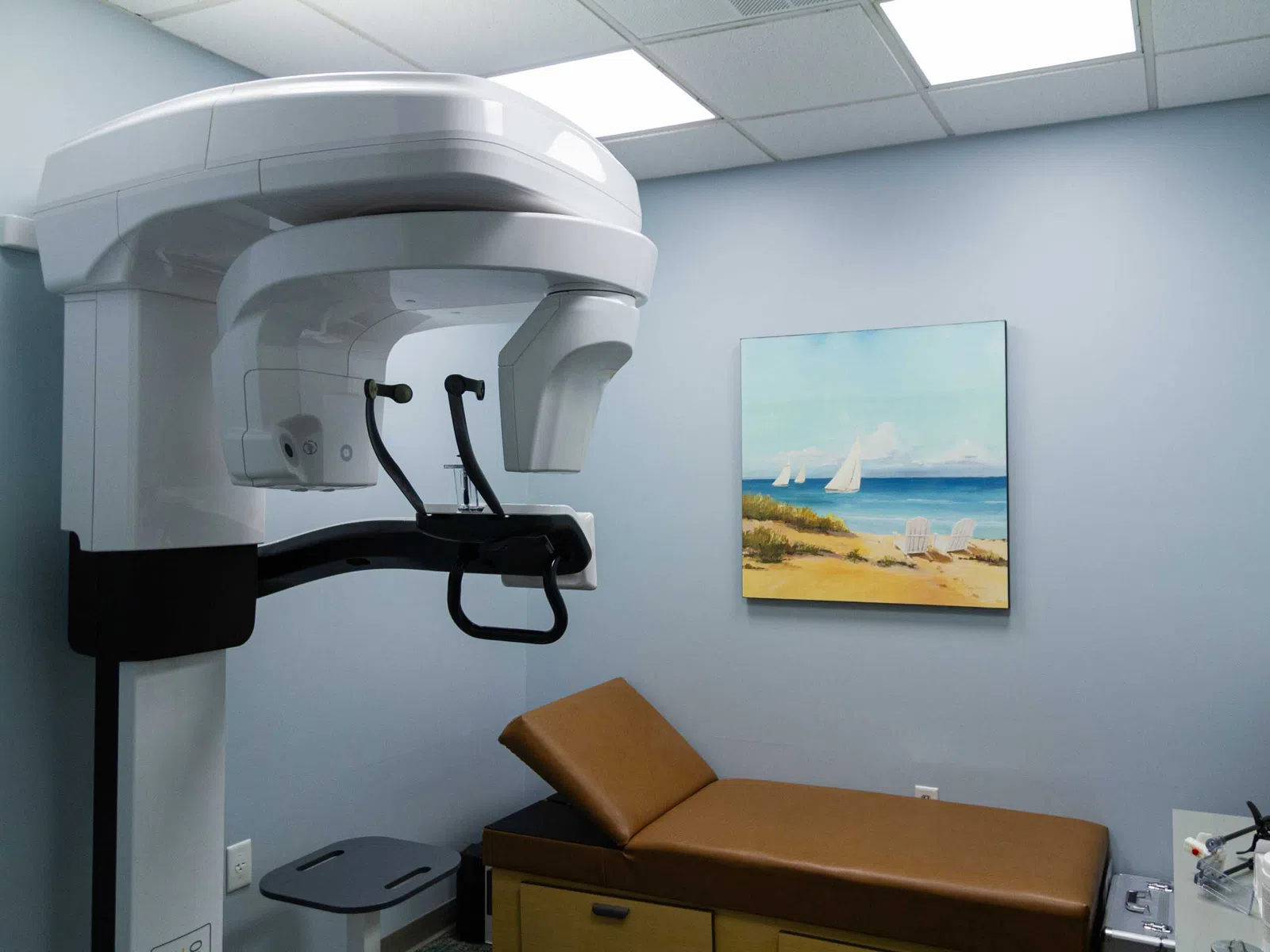
Our team uses a cone beam CT in Norfolk to capture a 3-D image of your teeth and jaw in one smooth rotation. The scan shows how much bone is available and where important nerves are located. Your surgeon can then plan implants or map the location of trapped teeth with far greater detail. The process is quick and uses a low radiation dose.
You can view the images alongside your surgeon, which makes your treatment options easier to understand. Clear images also help avoid surprises once your treatment begins. Schedule a consultation to see how 3-D imaging can guide your surgical care.
Learn What a 3-D Scan Can Reveal About Your Jaw
A 3-D scan can reveal hidden structures in your jaw that flat X-rays don't fully show. For implant planning, digital scanning helps your surgeon measure bone width and pinpoint the sinuses.
Before wisdom teeth removal, a cone beam CT scan shows how close roots sit to the jaw nerve. It also helps locate impacted canines or extra teeth and reveals cysts growing inside the bone.
Getting scanned is simple. You'll remove metal items like earrings, then stand or sit while the machine circles your head. All you have to do is hold still for a few seconds to ensure clear images.
Your surgeon will review the 3-D model from every angle and use it to plan each step. For guided implant surgery, the same scan becomes the foundation for robotic or navigated placement.
Enjoy precise treatment using our cone beam CT in Norfolk. Contact us today for a consultation.
Hidden Problems Found
The digital scan uncovers cysts or trapped teeth that may not appear on standard dental X-rays.
Nerve-Safe Planning
Mapping the jaw nerve in 3D helps your surgeon avoid it during extractions and implant placement.
Right-Sized Implants
Precise bone measurements help your surgeon choose an implant that fits your jaw securely and lasts for years.
Versatile Diagnostic Scan
A single scan can guide several treatments, from extractions to implants, without repeated imaging visits.
Clear Visual Explanations
Seeing your own 3D images helps you understand your diagnosis and feel confident about your next steps.
Frequently Asked Questions About a Cone Beam CT
Q What does CBCT stand for?
CBCT stands for cone beam computed tomography. The name comes from the cone-shaped X-ray beam the machine uses to capture images. As it rotates around the head, it collects many pictures in one pass. Software then combines them into a detailed 3-D model of the jaw and teeth. Dental specialists rely on it for planning.
Q Is a cone beam CT the same as a medical CT?
A cone beam CT is not the same as a medical CT, though both create 3-D images. Cone beam machines are smaller and designed for the teeth and jaws. They use a lower radiation dose and take less time. Medical CT scanners image larger areas of the body and show soft tissue in more detail.
Q Can cone beam CT help evaluate TMJ problems?
Cone beam CT can help evaluate TMJ problems by showing the bony parts of the jaw joint in 3-D. It reveals changes like bone wear or flattening. It does not show the soft disc inside the joint well, so an MRI may be added when needed. Together, these images guide treatment planning.
Q Can I get a copy of my cone beam CT scan?
You can usually get a copy of your cone beam CT scan by requesting it from the office. Scans are often shared through a secure link or flash drive. Having a copy is helpful for second opinions or when seeing a new provider. Privacy laws protect your records and how they're shared.
Q Can I have a cone beam CT scan with fillings or braces?
You can have a cone beam CT scan with fillings or braces. Metal can create small streaks on the images, but the scan still provides useful information. Removable metal items like jewelry should come off beforehand. Your provider adjusts settings when needed to keep images clear around fixed metal work.
Q How often can cone beam CT scans be taken safely?
Cone beam CT scans can be taken safely when there is a clear clinical reason. There is no set yearly limit, but providers follow the principle of using the lowest dose needed. Most people need only one scan for treatment planning. Follow-up scans may help confirm healing after grafting or implant placement.
Q Is a cone beam CT scan claustrophobic?
A cone beam CT scan is not claustrophobic for most people because the machine is open. You sit or stand while the arm rotates around your head, with nothing enclosing your body. The scan lasts under a minute. People who feel anxious can close their eyes and breathe slowly during the rotation.
Q Can cone beam CT detect oral cancer?
Cone beam CT is not designed to detect oral cancer in soft tissue. It mainly shows bone and teeth. However, it can reveal changes in the jawbone that may need further testing. Oral cancer screenings and biopsies are the main ways to find and diagnose cancer in the mouth. MRI may be ordered when needed.

